I have been keeping bees for over a decade
and I still make lots of mistakes.
This year I hope to do better.

Online Beekeeping Supplies

March 21st, 2009

Mail Order Beekeeping Supplies

I’ve been buying my woodware from mail order houses. There are no retail bee stores within easy driving distance. I would much rather touch the stuff that I am going to buy, but I can’t so I have to make do with a brief description and a fuzzy picture.

The main problem with buying hives and supers via mail order is that they are heavy. The shipping costs are nasty. I’ve been paying upwards to $60 every time I make a big order.

I decided to spend a few minutes Googling for beekeeper supplies and make a list of websites, their locations and the cost of three items so you can compare. It is better, however to buy from a nearby location than the cheapest place. The shipping price can triple to send heavy boxes across the country.

I want to compare the price of 1) a 10 frame hive kit with top and bottom board and frames. 2) a medium super unassembled. And 3) a cheap bee feeder.

The list is quite short. I only chose websites that were high on the Google list and I only chose websites that had the products that I wanted to compare. There is a deep hive kit that consists of a hive and super that goes for around $100 at Dadant, but Dadant.com did not have the single hive body kit. The deep hive is good deal, but it would not compare well here. I was also amazed at the range in cost of the beginner’s complete kits. They went from cheap to expensive, but I don’t have the time to figure out why.

Some stores don’t have ecommerce stores and you have to fill out an order form and mail it in. I even found one place that had good price stuff that didn’t accept credit cards. I could set them up with a paypal store in a few hours.

The List:

Store Location Unassembled Hive Kit
(45 pounds)
Unassembled Medium Super
(7 pounds)
Entrance Feeder (less than 1 pound)
Betterbee Greenwich, NY $61.95 (styrene top. Pierco frames) $11.55 $2.00
Brushy Mountain Bee Farm Moravian Falls, NC $56.95 $11.50 $2.35
Mann Lake Ltd. Store Hackensack, MN and Woodland, CA $78.50 (assembled) $9.35 $2.95
Ruhl Bee Supply Gladstone, OR $83.00 (assembled) $15.00 ?
Sacramento Beekeeping Sacremento, CA $69.85 $13.95 $3.95

HoneyFlowerFarm has a very nice resources page that lists these and others. Many, however, have broken links or do not have ecommerce set up.

Please email me with your favorite online store and the prices you found. These are all east or west coast, what happened to the middle? Where is Canada, Australia and England?

Woodware – Buy or Build?

March 20th, 2009

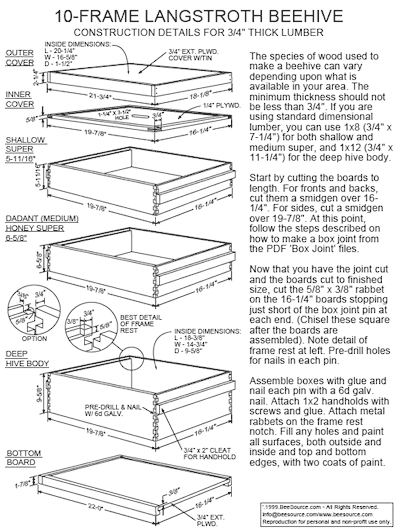
The wooden beehive parts are called woodware. A Langstroth hive is very simple to make. The hives use rabbet joints which are interlocking wood joints that make the box strong and stable. If you are have the right stuff you can make dovetail joints. If, like me, you just aren’t good at carpentry, you can just use screws and butt joints, which are probably just fine.

A precut and unassembled hive with an assembled bottom board, divider board and telescoping top covered with stainless steel, costs about $60 at most of the online shops. It weighs 57 pounds and shipping is about $25. This includes frames.
Making your own hive costs about $30-$40 worth of lumber and two or three hours of time.

It’s the time that gets you. You have to drive to the lumber yard and get an 8 foot length of 1x12x8 shelving that is relatively free of bad knots. You need a half sheet of 3/4 inch sheathing (5/8 will do just fine), and a half sheet of 1/4 inch plywood. You need as piece of sheet metal, or sanded tar paper for the cover to keep the rain off. The trip will kill an hour and cost something for gas.

You need to rip the lumber down to 9-5/8 (and probably go back to the lumber store when you screw it up). You need to chop the sides and then cut the rabbets. You have to cut the top and bottom sidepieces and the plywood parts. You need either a dado blade on a table saw or a router to cut the grooves in the bottom and top sidepieces and the shelf for the frames.

You need to assemble and glue the top and bottom. You need to cut and attach the sheet metal to the top.

All this should take more than an hour to set up and get right. To be safe I am saying that it takes two hours with restarts and beer breaks.

Pay yourself $7 an hour and add about $20 to the cost of the project. You are probably worth more than this, but I am paying you MacDonald’s wages for even thinking that this is going to come out well.

The hive kits include the unassembled frames. You have to pay about $15 to get these shipped to your house, and you have to buy the foundation anyway.

Let’s total it up:
$35 in lumber + $20 labor + $15 frames =Total $70

If you bought the unassembled kit for $60 plus $25 shipping, you’d pay $85.
So you saved about $15, more or less.

You also spent 3 hours on a Saturday morning risking your fingers on the table saw and producing a product inferior to the mass produced ones. You could have been out at a game, or sleeping late, or having a good time doing almost anything else.

If you are still interested, www.Beesource.com has Hive Plans.

Could You, Should You Keep Bees

March 19th, 2009

Obviously, if you are reading this, you are thinking about keeping bees. There are any number of positive reasons for keeping bees, but I think we might consider some of the negatives. Here are some reasons why you might decide not to keep bees.

First, bees sting. Honey bees give you little love stings that smart a little and bother you a little, but aren’t like wasp stings and in fact are not much more annoying than a mosquito bite. If you don’t want to be stung, don’t keep bees. If the prospects of feeling a little pain are too frightening, then you will not be happy keeping bees. Sure, you can wear bee suits and full body bee armor, but you will be stung and you probably will be stung every time you open your hive, even with a bee suit.

If there is anyone nearby who is allergic to bee stings then don’t raise bees. Honey bees don’t bother most people, but that bratty neighbor kid is going to go into anaphylactic shock if he gets stung and the best way to do that is tell him to stay away from the bees. If you are a member of your family is allergic don’t do it. If a neighbor finds you have bees and a child is stung by a wasp you will be blamed anyway and probably sued. Bees work best when there are no people around to drag them into court. If you live in a crowded neighborhood keep your bees secret.

Some people don’t like bees and don’t want bees around. They will claim to be allergic or they will find some health department rule to keep you from keeping bees. You hives should be well hidden from neighbors. If you live in the midst of nasty people, consider some other hobby.

You have to have a good place to put the hive. It should be 100 feet from your doorway, driveway and front walk. The bees probably won’t bother you, but if the hive is close, you could get into problems. Bees like the smell of perfume and you great aunt who drenches herself in Obsession will find some bee friends that are very interested in her as she waits for you at the front door. It is hardly ever an issue, but it is best if the bees don’t live too close. You can keep bees on a 1/8 acre lot, but it is best if you have a little room.

You need a secluded place where young boys won’t be tempted to tip the hive or throw rocks at it. You need a place where raccoons and bears and even the occasional deer will not bother the hive. It needs a nice sunny exposure, especially in the winter, but it should be out of the wind.

If you keep bees you can’t use insecticides on your lawn, shrubs or trees. The insecticides will kill the bees. If you live in a neighborhood where everyone wants to pour toxic chemicals on their lawns, you bees will not thrive. Your lawn should contain wild flowers and clover. Don’t treat it with chemicals. Don’t mow it very often. You want a flowery meadow when you have bees, not a well manicured lawn.

You have to understand that it is against the law to sell honey without a permit from the board of health and regular inspections. You can sell a few jars at garage sales and flea markets and you can give honey as presents, but as soon as you start selling enough to make a good profit you will be fined for not following very stringent health and food quality laws. You will not get rich easily from raising bees in your back yard.

Bees aren’t cheap. You can get started for about $250. You may never get that much back selling honey at the church bazaar. You have to spend money on bee medicine and you probably will get more wood ware as the hive grows. You may want to split your hive and have to buy more equipment. You should expect to make back your investment in satisfaction rather than a concrete return on investment.

Bees are a hefty investment in time. Mostly the bees raise themselves, but you have to check them almost every day. You have to feed them, medicate them, and monitor their progress. You have to be aware that the hive could die very quickly, and they could also grow very quickly causing swarms which will not go over big with your neighbors. You have to harvest the honey, but not leave the bees destitute or the hive will die. You have to feed them in the winter so they won’t starve.

Bees require an investment in education. You have to read books and search web pages and ask a lot of questions. You have to be a hive expert and you need to get this expertise before your hive dies. You have to be armed with lots of knowledge even before you get your first 3 pound box of bees. If you don’t think that you need much mental effort and you can breeze through this, then don’t get started.

Beekeeping is a continuing project. It is not something that you start and then give up on. The hive is alive and you have a responsibility to maintain the hive or find someone else to take it. The bees learn to recognize the beekeeper and, although they are not like pets, the beekeeper and the bees will have a bond. It was once believed that if the beekeeper died the bees would miss the person and the hive would fail. The poem Telling The Bees by John Greenleaf Whittier is about telling the hive that their mistress has died. Be prepared to commit yourself to your hive. You must give it name and talk to her so the bees know you.

If you have read all of this and you still want to raise bees, then good for you. Bees are very cool.

The best color to paint a beehive

March 18th, 2009

When I got my hive delivered, Erica and I decided that it should be camouflaged so that the neighbors would not notice it and complain. I bought a dark brown semi-gloss house paint. After I painted it, I began to worry about the color. After all, almost all beehives are white. Was I wrong to paint it a dark color? It was a very dark brown and nothing like any beehive I’ve ever seen.

Well, bees naturally live in holes in trees and logs and other dark protected areas. In the wild their houses are always dark brown. Brown might be a better color than white.

After research, I have found that white is used because it is a clean color and stands out. It is easy for the beekeeper to see. In reality, beekeepers paint their hive with the cheapest paint around and only paint them to protect the wood. The inside of the box should not be painted. Wood preservatives may harm the bees. Latex paint is better than oil based just because the oils may vaporize and harm the bees.

There is a school of thought that says you should decorate the beehive with big bold designs so that the bees will recognize it. This will help them find the hive.

This link: Palazzo Rospo: Beautimous Bee Hives, has some nice creative work on a beehive.

Italian, Carniolan or Russian?

March 17th, 2009

I ordered a package of Carniolan bees back in February. I later decided to get another package so that I could raise two colonies. It has been suggested in more than one book that two colonies is better than one. First, you can compare hives and quickly determine when one is doing poorly and needs help. It is also insurance that if one hive dies, then you still have one hive left.

Having more than one hive, even for a beginner like me, makes sense. However, I made the decision to go with another package too late. Bees are usually sold out by March 1st; in fact, most bees are sold out by February 1st.

I found a seller in Rhode Island who has a number of nucs for sale and I ordered two. He had a kind of Italian Bee called a Minnesota Hygienic. He also had a kind called Russian. I did not know anything about the Russians, but I had read an article about the Minnesota Hygienic bees that strongly recommended them because of their natural resistance to several bee diseases. I ordered two nucs of the Minnesota Italians.

Now, after the fact, I’ve decided to look into the different bee breeds. These are all pretty much the same bee with different genetic features. They are the same species, but different subspecies or crossbreeds. They are like different races of bees, although the differences can be striking.

Golden Italian

The Golden Italian Honey bee has been the main bee of beekeepers for many years. It is a good beginner’s bee. I found a list of some of its strong points, including: Readily builds comb, Light color so it makes it easy to find a queen, Good at finding pollen, Doesn’t swarm as much as other bees, Relatively calm and gentle, resistant to foulbrood disease, Doesn’t make as much propolis (bee glue).

On the minus side, the Italians keep laying eggs and making brood even when there is no food source so they can starve if not watched. They build a lot of comb that is not for honey or brood – the structural comb called brace and burr. They drift, which means they can wander off.

The Italian bee seems to be a good all around choice.

The Minnesota Hygienic is an Italian hybrid developed by Dr. Marla Spivak at the University of Minnesota Bee Lab. They are called hygienic because they are particularly good at cleaning out sick larva and pupa, which makes them better able to fight off American Foulbrood and Chalkbrood.

Carniolan bees.

Carniolan bees or Carnies were imported from Slovenia because they are resistant to insect pests and it is very gentle. It is almost as popular with beekeepers as the Italian Honey Bee. It is a darker brown bee, not as golden color as the Italians.

There are lots of things to like about the Carniolan bee. Among other things it has a rapid buildup in early spring, even before flowers bloom. It is very gentle and non aggressive. It survives well in the winter. It regulates its size better than the Italians so it is less likely to starve as the food supply declines.

On the other hand, it swarms at the drop of a hat, especially when there is a good food supply and as pollen decreases, the size of the brood substantially decreases.

Russian Honey Bees

Russian bees have been imported in the last 20 years because they are naturally resistant to varroa mites. Varroa mites seem to be a big problem in recently, and the Russians, coming from the place where varroa mites originated, is genetically resistant to the mites.

The geneticist Thomas E. Rinderer traveled to Russia’s Pacific coast area called the Primorsky Territory in 1996. He brought back 100 queen bees. The bees proved to be mite resistant and beekeepers have been trying them out with great success.

The Russian bees have many good points. Besides mite resistance, they are good at surviving harsh winters. They have a quick spring buildup so they increase in numbers during peak honey production season.

On the minus side they tend to swarm more than other bees. Until recently they were more expensive.

There are a number of other bee types. Many of them are Brand name hybrids that have been developed at bee farms for certain characteristics. Your mileage may vary. I am hoping that we will be able to buy queens that are proven resistant to Colony Collapse Disorder.

By accident, I think I did OK. The Carniolan Bees that I ordered for May are a good bee. The Italians that I will be getting in mid April are also a good choice. I should have ordered a nuc of Russians, just so I would cover all bases, but I don’t want to get crazy. Maybe next year, when I figure out how to split a hive, I’ll get a Russian queen.

What is a Bee Nuc?

March 16th, 2009


A Nuc, pronounced nuke, is a nuclear hive. It is four or five frames from a working hive including a queen.

When you get bees, you can obtain your colony in two ways. First is with a Package. Package bees come in a screened cage the size of a shoebox. There are three pounds of bees (upwards to 10,000) in the package. There is a can of sugar syrup in the cage and a queen in a box. The bees are grabbed from an existing hive and the queen is breed separately and may not be related to the hive. You put the package in your hive and let them get used to the queen. If you feed them enough and all goes well, then maybe they will all get along and start a colony. In three or four weeks the hive will be established and start increasing.

A Nuc on the other hand, is 4 or 5 frames from an existing hive. It is a colony that had been working well for a time and the bees know and are related to their queen. The frames contain honey and pollen and eggs and larva. The frames were pulled from a working hive. This is the nucleus of a hive. If you feed the bees and keep them happy, they already have a good start and will stand a better chance of success than a package.

A nuc comes in a nuc box. It is usually a cardboard hive. The cardboard nuc boxes cost less than $7. (My supplier is charging $5.) You can get wooden nuc boxes for a bit more, but these are real, but small, hive boxes.

Bee suppliers don’t always have nucs and they cost more. The package bees come from huge bee breeding farms in the south. Nucs, on the other hand, come from successful beekeepers who produce the nucs to make extra money. Package bees are cheap and easy and are usually successful, but come later in the spring and don’t start really working until the summer, which is long after the first spring honey season. You have to feed and care for Package Bees. They might need a gallon or more of sugar a day for the first month. Nucs need feeding, but are also out working the flowers right away.

This spring I will be receiving two Nucs in April and a Package in May. I decided that I did not want to put all my eggs in one basket so I decided on three hives. This way I will have a better chance of success. I will also be able to compare the progress of the three hives to see how they compare.

My goal is to get a little honey this summer and fall. I then hope that the bees stay healthy and happy through the winter and increase in the spring. If I do everything right and I don’t kill my bees I can then split the hives in the spring. If I get six hives I will place three in a few friends’ yards. In two years I hope to sell some nucs myself.

Right now I am a total novice, without experience. I have high hopes, though. I am a quick learner. This time next year I hope to be experienced enough at this to hold some classes – another source of income.

Links:
Plans for a 5 frame nuc
MDASplitter.com “Splitter Box”

Found Nucs

March 15th, 2009

I found a bee keeper with “lots” of Nucs, and I am putting in for two Minnesota Hygenic (Italian) Queens. He also has Russian Queens.

I will be driving down April 4 or 5.

If anyone local needs one, you’ll need to get me a box and 5 frames to exchange. I would ask for a donation for gas as it is 200 miles each way.

Taking the Plunge

March 13th, 2009

In late February of 2009, I decided to go for it. I ordered a starter pack of bees from BetterBee up in Greenwich, NY. I will be picking up the bees in May. I chose Betterbee because they are in an area I know. They are three hours drive from my house, but I don’t think that I mind that. There were other places around, including an ad on craiglist, but the Betterbee starter packs were less expensive and they seemed to be more together than the other locations.

I bought the hive from Brushy Mountain Bee Farms. They had the best prices (although their shipping was high). I bought a starter package from them, which was a great value when added up. I think it was quite a bit less than the other websites. They shipped it and it has arrived. I will get pictures of it this weekend.

The Brushy mountain box included a DVD from 1991 that was a little slow moving, but still had some interesting information. It included the book First Lessons in Beekeeping by Keith S. Delaplane. I must say that I thought the book was excellent. It covered everything very clearly and I recommend it highly. Order it through Brushy Mountain because it costs over $40 on Amazon.

The book did not downplay the problems that beekeepers have. I had some sleepless nights worrying about my future colony of bees. I want them to succeed, but the book listed so many things that can go wrong. There are problems with the bees and mites and diseases. If you hive is too successful it can split and half the bees run for a new home. If the queen dies it can mean disaster. I am seriously worried.

My next step is to order some “supers”. These are boxes that go on top of the hive. After reading things on the internet and Delaplane’s book, a single hive box is not enough room for the hive to thrive. I have to make some more room. I am also considering getting another hive box and starting a second backup colony. The odds are pretty good that the hive will die, and I want to be prepared with a second colony, just in case.

I will call Betterbee today and see if it is possible to get another starter package of bees.

First bee post

March 4th, 2009


This is the first post.

It starts here.


Bee Progress Home


Copyright 2009, 2010 by Keith P. Graham