I was very upset to read that bee colonies have very real problems with disease. Apart from killing the bees outright by mismanagement, bees suffer from a variety of health problems. In fact, almost 40% of all bee colonies die during the year. Many of them die over the winter, but disease, mismanagement and pests can threaten a beehive all year round.
Here are the things to watch for.
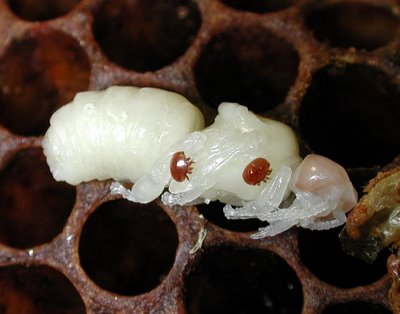 Varroa Mites
Probably the one problem that is bothering all beekeepers is Varroa mites. These mites attach themselves to bees, larva and pupa and weaken them. It is not an issue of whether or not you have these pests, but if they are enough to threaten the colony. Just about all hives have Varroa mite.
From the University of Kentucky Entomology web page:
Early detection of low levels of mite infestations is key to its successful management. While they can be spotted during colony inspection if present in high numbers, this tends to only identify larger infestations. There is a product available, Apistan, that will kill the mites and cause the mites to drop from the bees. Two strips should be hung in the brood nest area of the colony for approximately 4 weeks. This is to be used with sticky paper and a fine-mesh screen on the bottom board of a colony to capture any mites that may have been present. A considerable amount of cell cappings and other debris will also collect on the sticky paper, so it is best to inspect the sticky paper carefully for mites after removal. This method is able to detect low level infestations. Apistan strips are available from most of the large beekeeping suppliers and can be used both for detection and treatment of varroa infestations.
If a colony is found to be infested, all colonies at the site should be treated for mites with Apistan strips in the same manner. These strips contain the miticide fluvalinate and are not to be used during honey flow, or when there is surplus honey present in the colony that may be removed for human consumption at a later date. Therefore, late fall, after removal of surplus honey, or early spring, prior to honey flow, are the best times to treat for varroa mites.
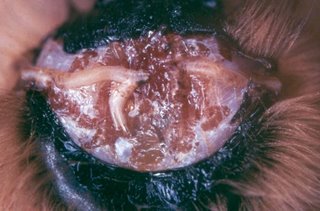 Acarine (Tracheal) mites
Tracheal mites get into the throat of bees and choke them to death. This pretty much killed every bee in England, and it took a while before the British beekeepers could recover. The mite entered the U.S. in 1984 and is still spreading. Brother Adam at the Buckfast Abbey create a hybrid called the Buckfast Bee that is resistant to these deadly mites.
The mites are hard to detect without a microscope, but is treatable with a special grease patty made of vegetable oil and sugar. Sometimes menthol is added to the patty and it disrupts the mites.
Nosema
Nosema is bee parasite that causes dysentery. It affects stressed bees, I am told, so it is important to treat bees that have been shipped to you as Bee Packages. It sometimes affects bees that are feeding on sugar water instead of honey.
The treatment is a shot of Fumigilin-B when you get the bees and once more in the fall to help the bees make it through the winter. A bottle with enough medicine to make 6 gallons is about $25.
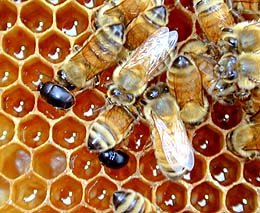 Small Hive Beetle
The small hive beetle is a pest that gets into the hive and grows in the comb, killing the young brrod and eating the honey. They will drive the bees out of the hive in search of clean living quarters.
The treatment is to put barriers around the hive to prevent it from entering. Pesticides can be used in a device that lets the small beetles get at the poison, but does not let in the bees.
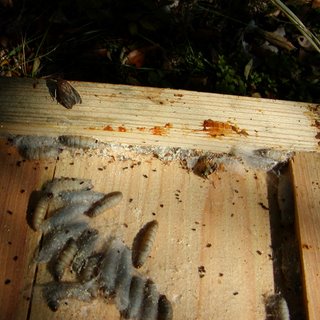 Wax moths
 don’t attack the bees, but eat the honeycombs. They like wax. This disrupts the honey and kills larva and pupa. The bees themselves usually kill the moths, but a sick colony may not be able to. Lots of wax moths is an indication that there is something wrong with the hive.
There are lots of treatments for Wax moths. Since they usually attack in the winter on parts of the comb where there are no bees, one thing is to remove the infected frame and let it freeze, exposed to the weather for 24 hours. The moths live in the warn hive, but die if frozen.
American foulbrood (AFB)
AFB is a nasty disease caused by a bacteria. It is one of the most common colony killers. The bacteria is present in most hives, but it usually only affects a weakened colony. Beekepers can smell the disease and there is a test you can do with a toothpick on dead larva – they have a ropey appearance.
There are some antibiotics that beekeepers can use as a prophylactic such as oxytetracyclene, but it is not recommended that the colony be treated until the beekeeper is sure that the hive is infected.
The treatment is to burn the hive and frames. The disease is known to stay in an unused hive for 40 years.
European foulbrood (EFB)
EFB is less deadly than AFB and is associated with a stressed hive. The hive usually recovers. Antibiotics can be used on a sick hive, but the antibiotics get into the honey so it can’t be used.
Chalkbrood
Chalkbrood is fungal disease that cause the brood to starve. The larva die and appear chalky white. It is a problem where humidity is high and the cure is to ventilate the hive.
Stonebrood
Stonebrood is another fungal disease. It causes mummification of the brood. It is also deadly to humans and other mammals.
Luckily a good hive will clean out the victims quickly and control the spread of the disease.
Bee viruses
There are a number of bee viruses including Acute bee paralysis virus (ABPV) or (APV) that are associated with Colony Collapse Disorder. These Dicistroviridae viruses have many forms. The actual connection to Colony Collapse disorder is not quite confirmed at this time although there is some evidence that there is a connection.
There’s not much you can do about a virus. Either colony dies or it doesn’t.
Colony Collapse Disorder (CCD)
Colony Collapse Disorder is a mysterious disorder. It is not classified as disease because the causal nature of the disorder is not proven, yet. It is a reference to the drastic increase in the number of colonies that just disappear. In a matter of weeks, sometimes a few days, the entire hive just wanders off and is presumed dead. The queen and some brood remain, but not enough to support the hive. The colony dies. There are no dead bees around the colony so it is hard to say what happened.
The disorder is associate with Varroa Mites, Nosema and other diseases, and is especially associated with a Dicistroviridae viruses. There have been some rumors that CCD is caused by a Dicistroviridae virus, but the final decision has not been verified, at least not officially.
Bee colonies are at a tremendous risk, especially to CCD. This is one reason why it is important for novice beekeepers like myself get into this on a hobby basis. The world needs its beehives. Professional beekeepers need all the backup they can get. Being an amateur pours money into the bee industry as the demand for bees goes up. We are helping to keep the bee infrastructure going while increasing the number of colonies.
I just hope my bees make it through the first months and I have something to be proud of this time next year.


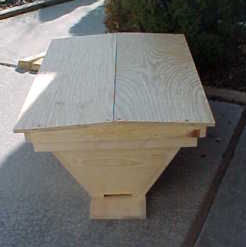 I started beekeeping this spring and have yet to actually have any bees. Still, learning about and preparing fo my bees is taking up a lot of my brain energy. I dream almost every night about bees.
 The Top Bar Hive takes advantage of this by making a hive with top bars and slanted sides. The bees naturally build their comb down from the bars and the bars a easily lifted to inspect. It is more economical than a Langstroth hive to build and there are no critical measurements so they can be built from scrap lumber in a variety of sizes.